
Conical Springs
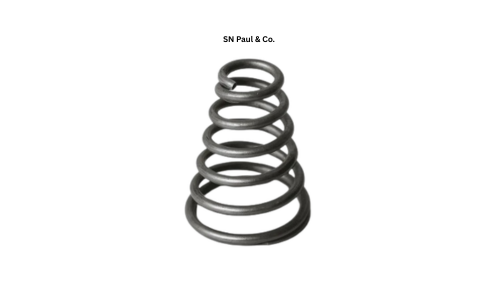
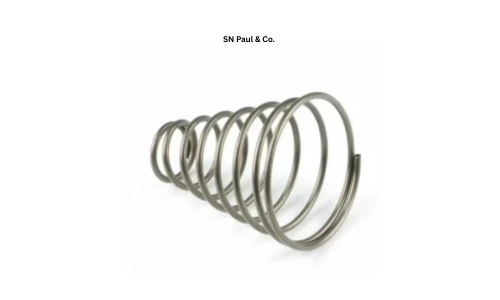
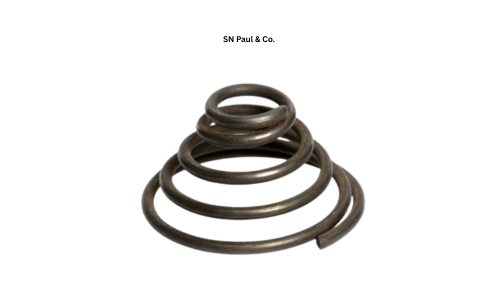
Our precision-engineered Conical Springs feature a tapered diameter configuration that delivers a progressive spring rate and an exceptionally low solid height. Designed to eliminate coil-lock and optimize performance in micro-clearance environments, these components are ideal for critical heavy-duty industrial assemblies.
S.N. Paul & Co. is a premier industrial manufacturing firm specializing in engineering high-resilience components for heavy machinery and infrastructure. With decades of industrial manufacturing expertise, we deliver precision-crafted mechanical solutions that meet international standards for durability and performance.
Conical Spring Manufacturer
Conical springs are expertly calculated to provide enhanced lateral stability and a reduced solid profile compared to standard cylindrical variants. Our multi-axis CNC coiling systems allow complete customization of pitch profiles, wire diameters, and tapering angles to meet exact structural load paths.
Specs of Manufacturing
- Wire Diameter Range: High-tensile round wire profiles engineered from 0.5 mm up to 45 mm.
- Outer Diameter Bounds: Base diameters scaled from tight 10 mm up to a expansive 450 mm.
- Solid Height Minimization: Engineered to achieve a collapsed thickness equal to a single or double wire diameter.
- Pitch Calibration: Available in uniform pitch configurations or variable pitch layouts for tailored load progression.
- End Formats: Supplied with ground, unground, open, or closed terminal coils squared to strict tolerances.
- Raw Materials Sourcing: High-carbon spring steels, Chrome-Silicon (CrSi) alloys, and corrosion-resistant Stainless Steel grades (SUS302 / SUS316).
Understanding Conical Spring Mechanics That We'll Supply
A Conical Spring is a compression spring wound in a distinct cone-like geometry where the top diameter is significantly smaller than the bottom base diameter. Unlike a conventional helical coil spring that features an identical cross-section over its entire length, the changing profile diameter alters the mechanical properties dynamically across the spring body during displacement.
The most remarkable capability of this architecture is its nesting capacity. If the taper angle is designed correctly, each coil can collapse inside the adjacent larger coil when loaded. This allows the fully compressed spring to achieve a solid height that is virtually flush with the housing baseline, freeing up precious structural volume inside space-restricted machinery assemblies.
Advanced Architectural Benefits and Performance Traits
Integrating a customized conical profile into your equipment setup provides specific mechanical advantages over traditional uniform compression systems:
Progressive Load Acceleration
Because the larger active coils have a higher deflection index, they yield smoothly to lighter compression forces at the start of travel. As the load increases, these outer coils bottom out first, continuously reducing the number of active coils and shifting force to the smaller, stiffer inner turns. This generates a non-linear, progressive rate that naturally dampens heavy sudden surges without jarring shocks.
Elimination of Buckling and Lateral Sway
Standard long cylindrical springs often require internal alignment mandrels or external guide tubes to keep them from buckling or bowing horizontally under immense loads. The wide, weighted base geometry of a conical spring shifts its center of gravity down, providing excellent self-centering balance and structural stability without adding weight or frictional guide wear.
Resonance and Vibration Suppression
Cylindrical springs are prone to harmonic surging because all their active coils share an identical natural frequency. Conical configurations possess a continuously variable natural frequency from coil to coil. This prevents uniform acoustic wave amplification, making them exceptional at decoupling high-frequency vibration fields in automotive engines, aerospace valves, and vibrating industrial screens.
We Ensure Precision Treatment and Quality Control while Supplying
To eliminate micro-structural variances, our conical blanks undergo strict stress-relief tempering immediately after precision coiling. For demanding high-cycle environments, components undergo shot-peening to introduce compressive residual stresses along the wire surface, extending fatigue limits by up to 40%. Every production run is subjected to load-deflection mapping using automated digital testers to guarantee consistency from piece to piece.
Conical Spring Price Structure
Pricing configurations are calculated per production batch based on wire mass, tooling setups, and testing constraints, typically falling into the following structural price bands:
- Standard Precision Instrument Conicals: Fabricated from fine-gauge carbon wire or stainless steel for electronics and sub-assemblies. Estimated range from ₹ 350 to ₹ 1,800 per piece.
- Heavy Industrial Machine Conicals: Engineered from thick-gauge Chrome-Silicon alloy bars for stamping machinery and heavy-duty industrial buffers. Price ranges from ₹ 2,500 to ₹ 18,000+ per piece.